
Why Equipment Maintenance is a PADI Instructor’s Responsibility
June 11, 2025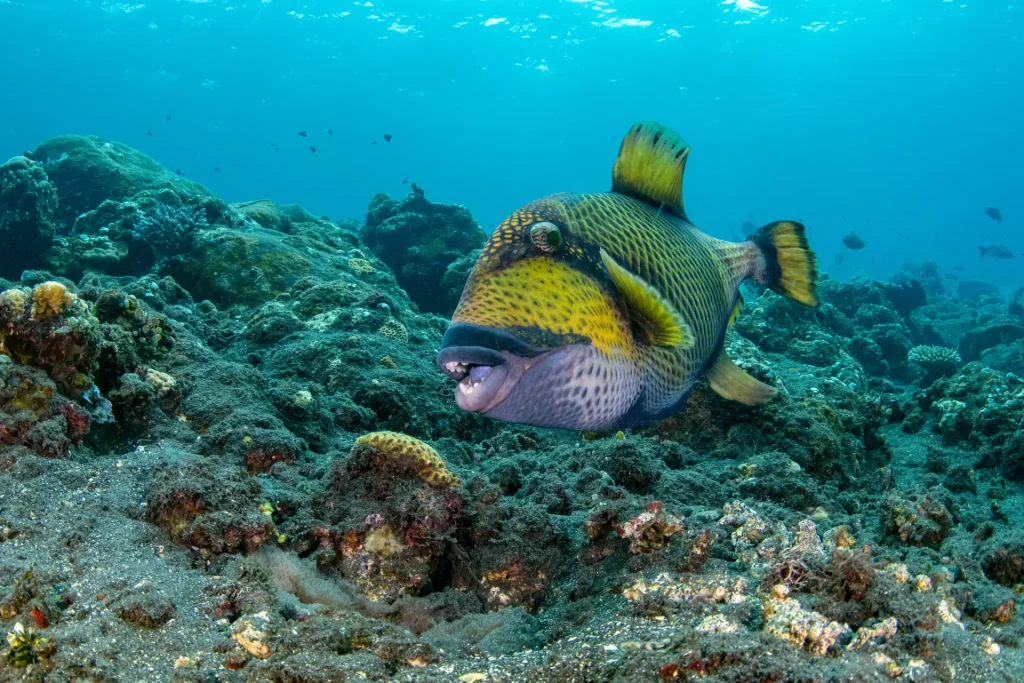
Titan Triggerfish: The Reef’s Most Misunderstood Guardian
Few fish command as much respect on a coral reef as the Titan triggerfish. Large, bold, and famously territorial, this powerful reef resident has earned a reputation among divers for its assertive behavior—especially during nesting season. Yet behind that reputation lies a fascinating and ecologically important species that plays a critical role in maintaining reef health.
Understanding the Titan triggerfish helps transform what some see as an intimidating encounter into one of the most memorable and educational experiences a diver can have.
Meet the Titan Triggerfish
The Titan triggerfish (Balistoides viridescens) is the largest triggerfish species found on Indo-Pacific reefs, and is often seen while scuba diving in Egypt and the Red Sea. Adults can grow up to 75 centimeters (about 30 inches) in length, making them an imposing presence on shallow reef flats and lagoons.
Key identifying features include:
- A pale body with fine patterning
- Bold facial markings resembling a mask
- Strong, protruding lips used for crushing prey
- A rigid dorsal “trigger” spine
The name “triggerfish” comes from the locking mechanism in their dorsal fin. When threatened, the fish can raise its first dorsal spine and lock it into place with the second spine, making it difficult for predators to pull them from crevices.
An Important Reef Engineer
Titan triggerfish are not just large reef fish—they are ecosystem engineers. Their diet consists primarily of hard-shelled invertebrates, including:
- Sea urchins
- Crabs
- Mollusks
- Starfish
Using their powerful jaws and strong teeth, they flip rocks, dig into sand, and crush shells to reach prey. This feeding behavior helps control sea urchin populations, which is particularly important because unchecked urchin numbers can overgraze reef areas.
By turning over substrate while feeding, Titan triggerfish also aerate sand patches and create microhabitats for smaller reef organisms.
The Famous Nesting Behavior
The Titan triggerfish’s bold reputation largely stems from its nesting season.
During breeding season, females create nests in sandy areas near coral reefs. These nests are shallow depressions where eggs are laid and carefully guarded. The female remains extremely protective, defending the nest aggressively against anything she perceives as a threat—including divers.
What many divers do not realize is that the nest defense zone is not just horizontal—it forms a cone-shaped territory extending upward in the water column. Swimming directly above a nest can be interpreted as a serious threat.
Understanding “Aggression”
While encounters can feel startling, Titan triggerfish are not aggressive without reason. Their behavior is defensive, not predatory.
If a diver unknowingly enters a nesting territory, the triggerfish may:
- Swim rapidly toward the intruder
- Make short darting movements
- Nip at fins if the diver does not retreat
Most encounters end quickly once the diver leaves the nesting zone.
How to Handle a Titan Triggerfish Encounter
Knowing how to respond makes all the difference.
- Stay calm and do not panic.
- Do not swim upward—this keeps you inside the cone-shaped territory.
- Turn and swim horizontally away from the fish.
- Keep your mask facing the fish while calmly exiting the area.
Rapid, erratic movements tend to prolong the interaction. Calm, controlled swimming usually ends it quickly.
Where Divers Commonly See Them
Titan triggerfish are typically found in:
- Shallow reef flats
- Sandy lagoons
- Coral rubble zones
- Outer reef slopes
They are especially common in warm, clear waters throughout the Indo-Pacific and are a regular sight for divers exploring Red Sea reefs.
A Fish with Personality
Outside of nesting season, Titan triggerfish are often curious rather than confrontational. Divers frequently observe them methodically turning rocks or blowing jets of water into sand while foraging.
Their expressive eyes and deliberate movements give them a surprisingly charismatic presence. Photographers often capture dramatic images of Titans against bright coral backdrops, showcasing their unique facial patterns.
Conservation and Reef Health
Like many reef species, Titan triggerfish depend on healthy coral ecosystems. Coral bleaching, habitat destruction, and pollution can all impact their feeding grounds and breeding sites.
Protecting reef environments ensures that species like the Titan triggerfish continue fulfilling their ecological roles. As predators of hard-shelled invertebrates, they contribute to the balance that keeps reefs functioning.
Responsible diving practices also play a role in conservation. Avoid disturbing sandy nesting areas, maintain proper buoyancy control, and never attempt to provoke wildlife for photographs.
From Fear to Fascination
The Titan triggerfish is often described as the reef’s “bulldog,” but this nickname overlooks its importance and complexity. What may initially feel intimidating becomes far more interesting when viewed through the lens of natural behavior and parental protection.
For divers who understand their habits, encounters with Titan triggerfish can be highlights of a dive—dynamic, memorable, and uniquely Red Sea.
Rather than fearing them, appreciating their role as devoted nest guardians and powerful reef engineers adds another layer of depth to the underwater experience. The Titan triggerfish is not simply the reef’s enforcer—it is one of its most dedicated protectors.